
Authentic Ancient Artifacts
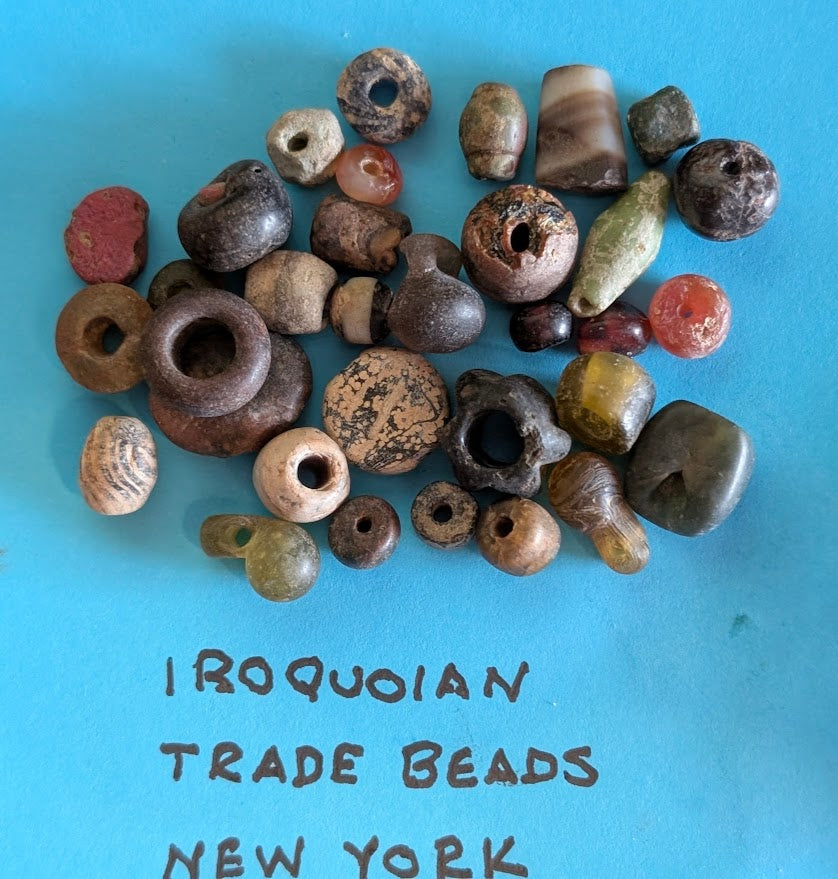
Iroquoian Trade Beads & Pendants – Prehistoric / Early Contact Period – New York Region
Iroquoian Trade Beads & Pendants – Prehistoric / Early Contact Period – New York Region
Enter your offer details
Couldn't load pickup availability
Arrowheads and beads weren’t just tools—they were often traded like money. Tribes valued them for their usefulness and skillful craftsmanship, making them a form of early currency in Native American trade long before coins came along.
This group consists of authentic Iroquoian trade beads and small pendants, recovered from the New York region, an area historically occupied by Iroquoian-speaking peoples (Haudenosaunee Confederacy).
The lot includes a diverse assortment of stone, mineral, and early glass beads, showing a range of sizes, drilling methods, and materials. These beads would have been used for personal adornment, ceremonial display, and trade, and some examples may represent early contact-era exchange items, while others likely predate European contact.
Materials visible include:
Stone (various local lithics)
Polished mineral beads
Early glass or proto-glass trade beads
Tubular, barrel, donut, and pendant forms
This variety strongly suggests long-term use and accumulation, rather than a modern assemblage.
Cultural & Historical Context
Iroquoian bead use spans late prehistoric through early colonial periods, roughly:
c. 1200–1700 CE
Beads served multiple purposes:
Indicators of status or identity
Components of ceremonial regalia
Objects of intertribal and colonial trade
Exchange goods with early Dutch and French traders
Stone and mineral beads often precede European contact, while glass beads typically indicate early contact (16th–17th century).
This mixed-material grouping is consistent with Iroquoian villages and trade networks in New York.
Manufacturing & Use Analysis
Drilling & Form
Several beads show biconical drilling, a hallmark of prehistoric stone bead production
Hole irregularity and asymmetry indicate hand drilling, not modern rotary tools
Wear polish around perforations suggests stringing and long-term use
Surface & Patina
Rounded edges
Natural surface smoothing
Mineral staining and soil patina
No evidence of modern tumbling or machine finishing
These are strong authenticity indicators.
Condition
Very Good – Authentic Field Grade
No modern breaks
Natural wear consistent with age and use
Several beads show significant smoothing from handling and stringing
Honest condition — not restored or altered
Authenticity Assessment
Based on:
Correct forms and materials
Period-appropriate drilling techniques
Natural wear patterns
Regional consistency
Estimated probability of authenticity: 90–95%
Assemblages like this are very difficult to fake convincingly due to the variety of materials and drilling styles.
Summary
A compelling and authentic group of Iroquoian trade beads and pendants from New York, spanning late prehistoric to early contact periods. The diversity of forms, materials, and wear patterns reflects real cultural use and trade activity, making this an excellent addition to a serious Native American artifact collection or educational display.
Ethical & Legal Note
These appear consistent with legally collected surface finds and historical trade materials from regions where private ownership is permitted. No burial or funerary context is implied.
Share