
Authentic Ancient Artifacts
Large 3.5" Beveled & Heavily Patinated Illinois Native American Projectile Point – Chert
Large 3.5" Beveled & Heavily Patinated Illinois Native American Projectile Point – Chert
Enter your offer details
Couldn't load pickup availability
Arrowheads and stone tools weren’t just tools—they were often traded like money. Tribes valued them for their usefulness and skillful craftsmanship, making them a form of early currency in Native American trade long before coins came along.
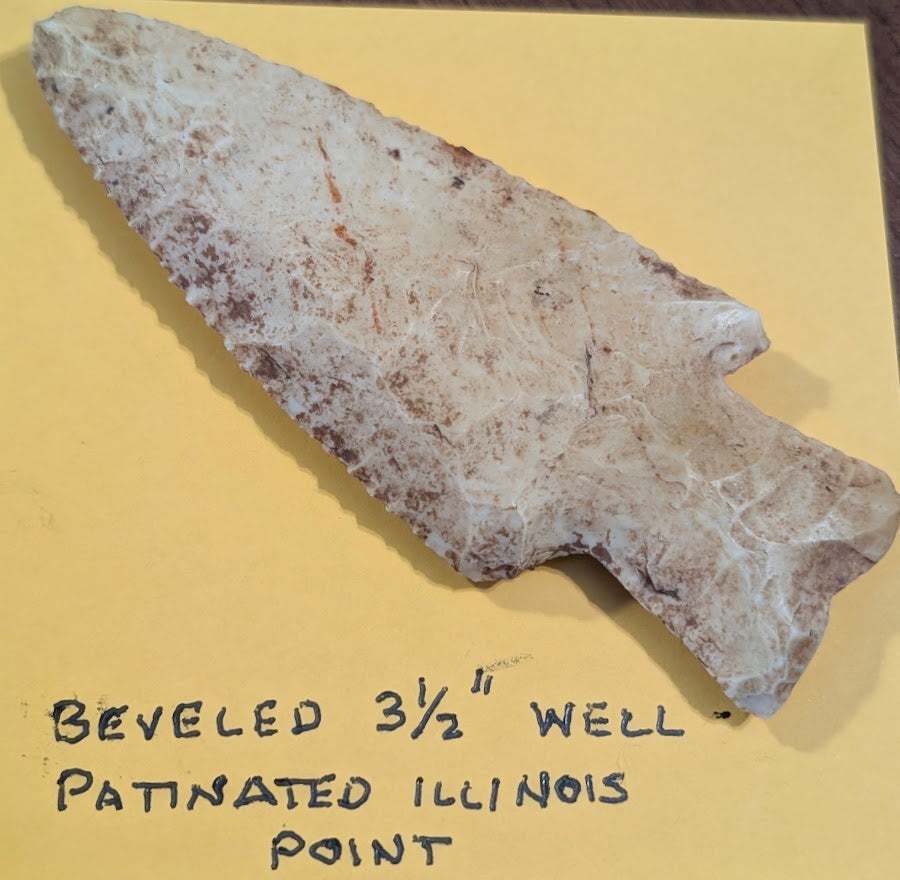
A large, impressive 3½-inch knapped stone projectile point / hafted knife, reportedly from Illinois, displaying substantial age-related surface patination and a broad, elongated blade. This is the kind of piece that commands attention in any collection — its creamy white patination, pronounced beveling, and complete form make it a standout display artifact.
The handwritten collector notation accompanying it reads: "BEVELED 3½" WELL-PATINATED ILLINOIS POINT."
Artifact Details
- Culture/Period: Prehistoric Native American, exact period undetermined
- Region: Illinois, per collector attribution
- Material: Chert/flint, probable
- Length: Approx. 3½ inches
- Form: Large projectile point / hafted knife
- Surface: Heavily patinated (cream/white)
- Type: Unclassified / attribution uncertain
Description
The artifact features a pronounced pointed tip, long convex-to-nearly-straight blade edges, a defined shoulder/hafting transition, and a broad basal area. The underlying stone appears consistent with chert/flint, a standard raw material for prehistoric Illinois chipped-stone tools.
At 3½ inches, this is large enough to be described as a projectile point or hafted knife rather than a simple arrowhead. Large Illinois points frequently represent dart, spear, or multipurpose hafted cutting implements. Visually, its size and workmanship are consistent with Archaic-period forms, though no definitive type assignment is made here.
Provenance & Authentication Notice
Sold as an unidentified prehistoric stone artifact based on collector attribution; exact age, culture, and archaeological type have not been independently authenticated. No specific find-site provenance documentation accompanies this piece. Buyers seeking formal authentication are encouraged to consult a qualified archaeologist or recognized authentication service.
Share